
Fat modification process systems
Convert refined oils into high-value specialty or customized fats with our fat modification process systems. Our integrated solutions include fat hardening, chemical or enzymatic interesterification, dry fractionation, and semi-continuous deodorization. The systems can be tailored to upstream refineries, operate as stand-alone processes, or supply feedstock for margarine or shortening lines. The result: efficient transformation of oils into customized, high-performance fats while boosting yield.
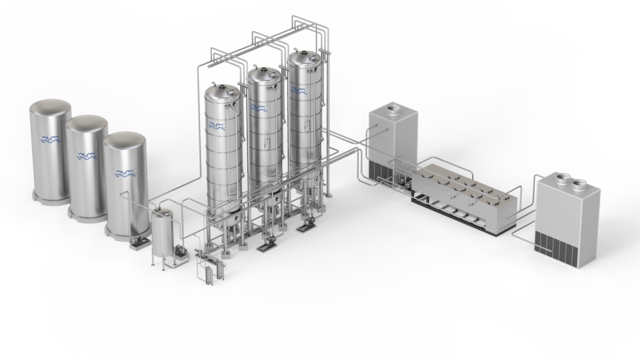
Why choose our fat modification process systems?
- Built-in flexibility for producing specialty or customized fats
- Adaptable to multiple purposes
- Low operating costs with minimal water and energy use
Gain greater flexibility to modify palm, animal or refined oils through dry fractionation, interesterification or deodorization. Achieve higher product value, better yield, and seamless compatibility with downstream margarine or shortening lines using fully integrated or stand-alone customized fat modification process systems from Alfa Laval.
Alfa Laval supplied us with a highly efficient plant, with the lowest production costs in terms of energy, hydrogen and catalyst consumption. It gives us unlimited flexibility to produce any type of fats we want,” - Alejandro Murillo, plant manager of CALSA – Cia Argentina de Levaduras S.A.I.C. – Argentina.
Tailored design for your fat modification needs
Every specialty or customized fats producer has different raw materials and production goals. That’s why Alfa Laval fast modification systems are customizable for processing palm oil, animal fats, or blends. Choose a single system, or combine several – dry fractionation, enzymatic or chemical interesterification, and deodorization – to meet your exact requirements. Doing so lets you achieve the consistent textures, melting properties, and high-quality output you need across your margarine, shortening, or specialty fats portfolio.
How dry fractionation works in Alfa Laval fat modification systems
Dry fractionation is a chemical-free, physical separation process ideal for palm oil, animal fats, and other feedstocks. It enables the production of customized end-products – such as margarine or frying oil - that match your customers’ exact specifications.
In continuous dry fractionation, the feedstock is separated into:
- Stearin - high melting-point solid fractions
- Olein - low melting-point liquid fractions
Cooling the oil takes place in a controlled way by carefully regulating the temperature, causing the higher-melting components to crystallize. These solid crystals are then mechanically separated from the liquid phase using membrane filter presses, producing two distinct products with different physical properties and melting points.
Batch-type dry fractionation system
For a batch-type dry fractionation system, the feedstock or refined palm oil enters the processing line. An external plate heat exchanger heats the feedstock to 65°C. Alternatively, the feedstock is heated inside the crystallizer to melt the crystalline structures before cooling takes place.
Next, the crystallizers reduce the feedstock temperature until the first crystals form and continue lowering the temperature to achieve the desired degree of crystallization. The cycle time of the dry fractionation process depends on the feedstock quality and final product quality desired.
After crystallization, the slurry passes through a membrane filter press, separating it into two products:
- Palm olein passes through the membrane and is forwarded to a storage tank.
- Palm stearin, which remains on the membrane, goes through further processing to remove as much olein as possible from the solid fraction for storage. Then, the stearin is dropped into a tank, melted by steam or hot water, and sent to storage.
Continuous dry fractionation system with batch-type option
The continuous dry fractionation process of palm oil is similar to batch dry fractionation. However, there are two differences in the configuration:
- A precooling section with plate heat exchangers to reduce the temperature of the palm oil before it enters the crystallizers.
- Pumps - one for each crystallizer and for the continuous transfer of the oil from the crystallizers to the buffer tank, accelerating processing time.
Compared to batch mode, continuous dry fractionation results in higher olein yield, generally the most valuable product, and reduces electricity and steam consumption by up to 40%. It also adds process flexibility to meet demand for products with iodine values (IV) 56.
Hydrogenation process
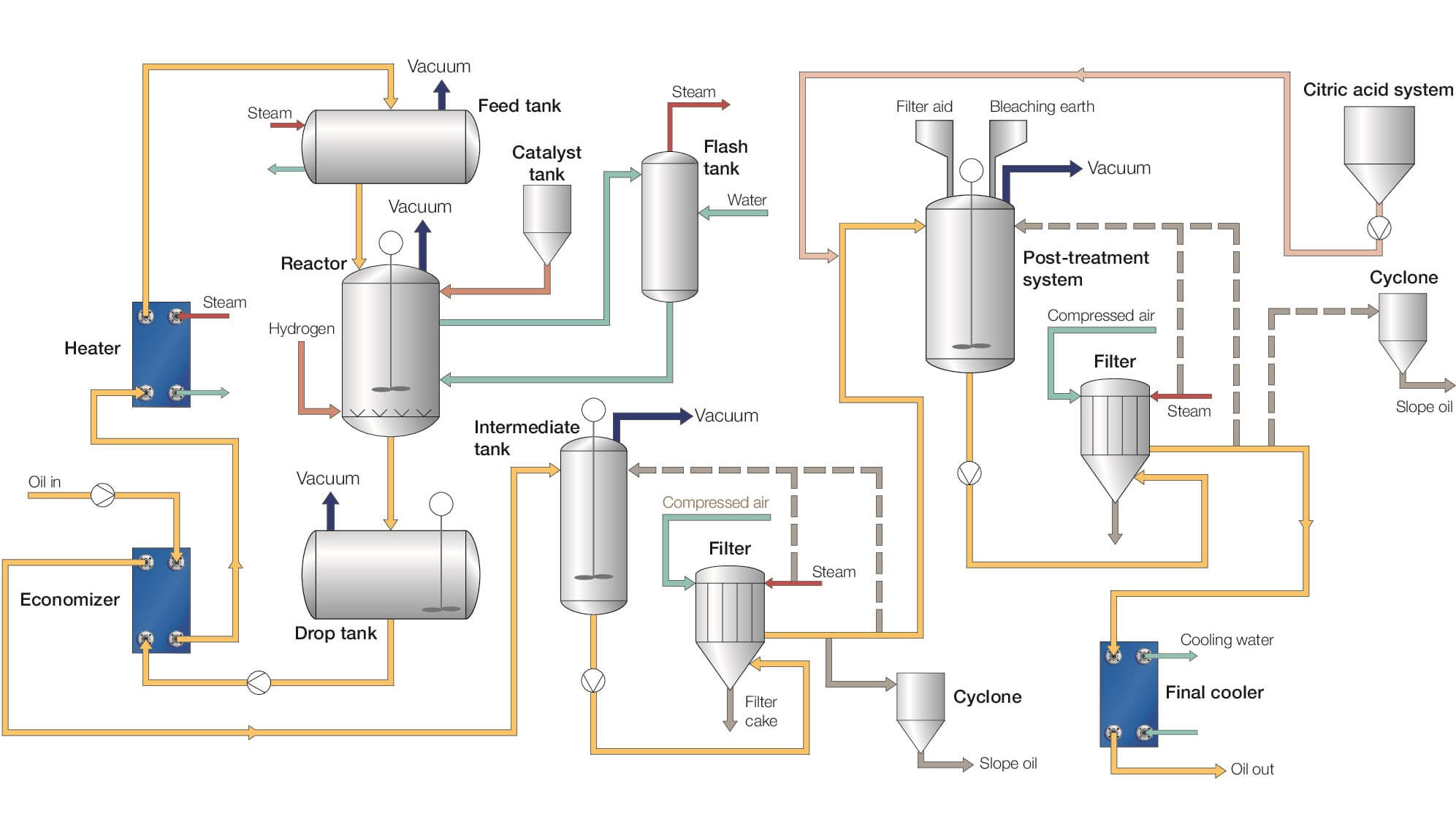 The versatile way to modify fats
Oils and fats from almost any type of raw material or ingredient can be modified into hard fats by altering their molecular structure through hydrogenation, a process in which hydrogen is chemically combined with unsaturated oils and fats by attaching to the double bonds of the unsaturated fatty acid chains.
Hydrogenation involves bubbling hydrogen gas through the oil at temperatures of 150°-200°C (302°–392°F), under pressure and in the presence of a catalyst. The hydrogen atoms saturate the double bonds, reducing unsaturated fatty acids or producing fully saturated fats. Hydrogenation raises the melting point of oils and fats and improves other properties, including taste, texture, stability and shelf life. The diagrams show two system designs for catalyst removal: one based on filtration and the other on continuous centrifugal separation.
Interesterification process
Interesterification can support keeping pace with evolving customer preferences through efficient, flexible production. By combining different oils and fats, interesterification makes it possible to produce hard fats from a wide range of raw materials while meeting modern market demands.
Traditional interesterification is carried out by using a chemical catalyst (normally sodium methylate) to bring about a regrouping of the position of the fatty acids on the basic glycerol molecule. Interesterification can also be supplied in an enzymatic version, selectively interesterfying in the glycerol 1 and 3 positions.
How interesterification works
A pump transfers a mixture of oils and fats from the mixing tank through a steam heater and into the reactor under vacuum conditions for effective drying. To improve drying efficiency, the oil is pumped through a recirculation section. After drying, a special dosing device introduces a catalyst into the oil recirculation stream.
Once the catalyst reaction has been completed, the oil is discharged to the post-treatment reactor to deactivate the catalyst using acid and the oil is treated using bleaching earth. As an alternative, the catalyst can be deactivated with water in the washing tank. The soap generated in this process is removed using a disc stack centrifuge. The oil is then dried and sent to the post-treatment stage.
Interesterification does not affect the degree of saturation of the fat, nor the location of the cis-trans chemical bonds. The process controls the consistency of the oils or fats at different temperatures, a parameter that is crucial for food manufacturers.
Customer's voice
CALSA – Cia Argentina de Levaduras S.A.I.C
CALSA chose Alfa Laval’s hydrogenation plant to boost efficiency, reliability and product quality. The system features a feed tank, a drop tank and a dead-end reactor. A highly efficient plate heat exchanger supports the system, optimizing heat recovery and reducing energy costs.
To ensure consistently high product purity, the plant uses a two-step catalyst removal system with direct filtration followed by post-treatment. A fully automated PLC control system streamlines operations, minimizes manual intervention, and delivers reliable, repeatable results while ensuring CALSA meet the strict food industry standards.
Alfa Laval supplied us with a highly efficient plant, with the lowest production costs in terms of energy, hydrogen and catalyst consumption. It gives us unlimited flexibility to produce any type of fats we want,”
- Alejandro Murillo, Plant Manager of CALSA, Argentina.

Webinars for the Edible Oil industry
Our experts share know-how to optimize edible oil refining processes, remove impurities and volatile components for better product quality, safety and yield.